The biggest fallacy of the Hall of Fame vote is trying to apply one argument to all players, which is what the steroids question has become. Doing this ignores how baseball has intertwined with US history when the moment is right, a tradition that should continue - and it would continue if the current class of journalists could just connect the dots.
The "blanket argument" is the steroids debate: should a player who used/is suspected of using steroids be allowed into Cooperstown? What isn't taken into account with this argument is the motives of the individual players, though - and motive makes a difference. Let's say, just for sake of the argument, that Jeff Bagwell took steroids for a couple of seasons. Whether Bagwell used can never be proven (and I don't believe he did), but some baseball writers believe he cheated during his career year. Fine. The next question to be asked should be "What was his motivation for cheating?" Only when you ask this question can players be judged on an individual basis.
If Bagwell cheated, he may have wanted to boost his numbers for a couple of seasons. Maybe he wanted a larger contract. This motive is common, and universally shared by all baseball players. Bagwell didn't want to become a baseball deity.
Let's pose the same question of motive to Barry Bonds... And now we see how two supposed cheaters look completely different. Barry Bonds had a God complex, something he wasn't shy about expressing. Bonds put Babe Ruth is his sight lines and set out to destroy his legacy. Bonds doesn't want you to talk about Babe Ruth without expressing first reverence to Bonds' career. That was Barry Bonds' motivation to cheat.
Whether a Hall of Fame voter sees a moral difference in the motivation of players like Bonds and Bagwell is up to them, but players should be judged upon their individual motivation and not a blanket judgement.
If I were a Hall of Fame voter, I'd bring US history into the equation when judging the motivation of a player to cheat. This is where Barry Bonds wanting to become a baseball deity should be seen as highly insulting, and his behavior should be used against him when considering his case for Cooperstown.
Anyone can tell you that Bonds deserves to be in Cooperstown because he was good enough before he cheated. When Bonds was young, he hit for average and power; and he had speed. He was a run producing machine, and if he just aged without wanted to become the great home run hitter ever, he would be remembered as a player with a really good eye at the plate and stats worthy enough to get him into Cooperstown. Bonds wouldn't have been Willie Mays or Mickey Mantle, but he would have a place below them.
This wasn't good enough for Barry Bonds. He wanted to be the greatest player ever. Period, end of story. And he wanted to be the greatest during an unfortunate chapter of American history.
When Babe Ruth became the greatest player in baseball history, America was riding a wave of prosperity. We came out on the winning side of the largest war in history, we weren't mired in trying to keep a crumbling empire together (see Britain, France); and we weren't castigated with punishments meant to cripple a nation (see Germany and the former Ottoman Empire). The stock market was up, Americans were earning higher incomes, our country's place in the world was rising, and Babe Ruth helped to symbolize all of this with his larger than life style of playing baseball. The feats of the United States and Babe Ruth went hand in hand, and Ruth became a metaphor for the Roaring 1920's.
Barry Bonds, on the other hand, tried to become a baseball deity by cheating during a time when banks were cheating the economy. Banks were signing up new homeowners despite knowing that these people didn't have enough income to pay the bills on these new mortgages, then packing these crappy mortgages into securities, giving them an AAA bond rating, and selling these securities to investors. It was false prosperity. And, like a steroid abusing baseball player who suffers from injuries later in his career because his muscles grew to a point where his body could no long support them, the mortgage backed securities collapsed - they almost bought the whole economy down with them.
It is merely a coincidence that Bonds cheated during this particular time in US history, so does he deserve to be punished for it? Yes, absolutely, 100% yes yes yes. Bonds tried to become Babe Ruth, so he asked to be compared to Babe Ruth. What Bonds doesn't understand, though, is that Babe Ruth is more than a baseball player - he's a historical metaphor. Thinking about "Babe Ruth" brings us back to America's glory years. And thinking about Barry Bonds brings us back to, well... It was only a few years ago, I think you remember.
Barry's surname is "Bonds," and those mortgage backed securities were, essentially, bonds. I mean, the metaphors should write themselves here.
Should a player who can become a metaphor for everything wrong with America be enshrined in the Hall of Fame? No, because that player is definitely no Babe Ruth.

Sunday, December 29, 2013

Wednesday, December 4, 2013
The Ellsbury Paradox
Jacoby Ellsbury has gotten himself into a fucked up situation by going to the Yankees. By going for the big money, Ellsbury (who will now, and forever, be known as "Ell$") has placed himself in a position where there's a good chance he'll tarnish his entire career. Here are four reasons why:
1) When the Yankees give you a big contract, they expect results - not just individual results, but world championships. But the Yankees are a total shitshow right now. Mariano is gone, Pettitte is gone, Jeter will be gone soon, nobody knows what's happening to A-Roid, there's a huge hole at second base if they can't pony up $200+ million for Cano; Sabathia and Teixeria look like they're declining, and the rest of the team sucks. By signing Ell$ and McCann, the Yankees sacrificed their first two picks in the 2014 draft - so getting prospects to come to the rescue will be a challenge. And if the Yankees have $100+ - $200+ million commitments to Ells$, A-Roid and Cano, then spending money to build right now will also be difficult.
In short: the Yankees are in quite a bind, and they have to feed a relentless fanbase. Blaming Ell$ for the Yankees' future failures is unfair, but NYC isn't known for being "fair." Ell$ willingly placed himself in this situation, so he'll have to reap it.
2) Ell$'s game primarily consists of being a speedster on the basepaths. Right now, he's the best leadoff hitter in baseball - but he's 30. Speed declines with age, so even if he has injury free seasons from now until the end of his contract (assuming the Yankees exercise their 8th year option on him), he'll be 39 with his speed declining each year. Elite sluggers like David Ortiz are able to weather the effects of age and still play at a high level, but speedsters cannot do this. So Ell$ is already setup to fail.
3) And Ell$ has an injury history. Avoiding injuries as he ages is something even the best of players have trouble doing. The first time Ell$ hits the disabled list, he is going to feel the hatred of the rabid Yankees fan base.
4) By going for the money, Ell$ burned all of his good will in Boston.
Considering the situation Ell$ has placed himself in - possibly audacious bad press, hated by fans, little possibility of earning another World Series ring - how will this look on Ell$'s resume for Cooperstown?
That resume would have looked a lot better if Ell$ took a hometown discount to continue playing for the Red Sox. Ortiz took a hometown discount, made it to another World Series, and he not only earned another ring but he placed himself in the "Best Postseason Hitter Ever" argument. Pedroia took the hometown discount and got himself a second ring. Both players have earned the love of the Boston fan base, have (or, almost in Ortiz's case, has had) secure careers, and all of this will look favorably upon them five years after each of them retire and find themselves on the ballot for Cooperstown.
Ell$ went for the money, but I doubt he comprehends the magnitude of his decision. Two decades from now, if he's a middling HOF candidate with little chance of being enshrined, I hope Ell$ is still enjoying all $153 million the Yankees paid to buy off his potential immortality.
Friday, November 15, 2013
Sabermetrician Douchebags (cc: @keithlaw)
It's awards time for baseball, that time of year when hardware is handed out to players and managers while Sabermetricians threaten to go on a five state killing spree if they don't get their way. I got tired of writing about this before the 2013 season and don't wish to start over again - hey, I need time to write a post about Mike Napoli where I eat some crow.
But I can't let this awards season pass without pointing out how pompous the Saber-douchebags are.
Blame can be applied to all parties for the pissing matches that happen during MLB awards time, but the lion's share of the blame must be given to Sabermetricians. Talking about baseball would be a lot more enjoyable if these douchebags got a fucking attitude adjustment.
But I can't let this awards season pass without pointing out how pompous the Saber-douchebags are.
Keith Law's tweet encapsulates the attitude problem that Sabermetricians have: they're pompous, smug pricks. They won't listen to any voice outside of their echo chamber because they just assume they're the most intelligent people ever.The BBWAA has failed its annual intelligence test. Again.
— keithlaw (@keithlaw) November 14, 2013
Blame can be applied to all parties for the pissing matches that happen during MLB awards time, but the lion's share of the blame must be given to Sabermetricians. Talking about baseball would be a lot more enjoyable if these douchebags got a fucking attitude adjustment.
Tuesday, November 12, 2013
On the Braves move, civil rights, and what baseball represents
Yesterday, regarding the Atlanta Braves announcement that they will move out of downtown Atlanta and into the suburbs, Grantland posted a map of the Greater Atlanta area that shows where Braves ticket buyers come from. Give it a look:
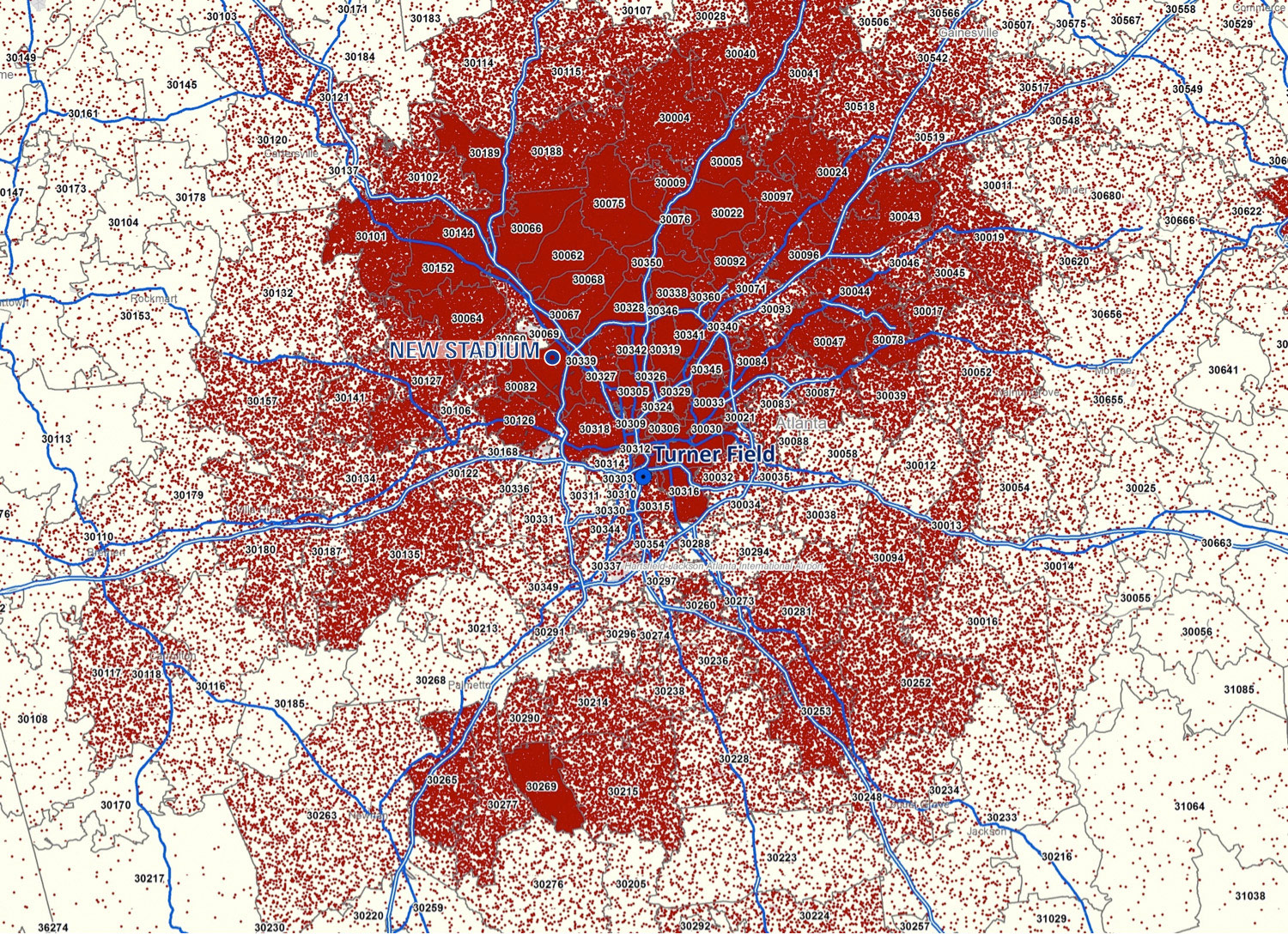
As you can see, Braves ticket buyers are coming from the north of the city of Atlanta - the suburbs. Not the generalize, but the suburban areas surrounding a city are usually pretty white in racial make up.
Looking at this map, I can't help but think of the bittersweet irony with the Braves organization wanting to move to Cobb County. Strictly as a business decision, does the move make sense? Yes. Despite the Braves currently playing in a relatively young stadium, they don't own it or control the surrounding area. Nor is the stadium close (relatively speaking) to where its fan base is located. That fan base, as you can generalize from looking at the map, is pretty white. But that's not what the Braves have traditionally represented.
The Braves moved from Milwaukee to Atlanta in 1966, and they took Hank Aaron with them. This was a big fucking deal. Think of the social landscape of America at that time. The Civil Rights movement gained steam in the 1950's and getting into even just the summaries of landmark events of that movement would lead to an incredibly large blog post, so mentioning a couple of the remarkable names will need to suffice: Rosa Parks, Martin Luther King, Malcolm X just to scrape off the top of the list. The South was fighting against desegregation, which led to George Wallace's run for president as a third party candidate in 1968 with a racist platform and won most of the South - Georgia included. This was an explosive time in American History, yet in the middle of it, the South - the Deep South, not just some Mason-Dixon border city near the North - got its first Major League Baseball franchise. And it came with an all star player who was black.
Pretty amazing. Baseball meant a lot more to American culture (not to mention peace, harmony, and unity) back then.
Other cities in the South could have tried to get a franchise. In this age, we think of Atlanta as a major city but that wasn't the case in the 1960's. Political leaders in Atlanta at that time realized the city's potential for growth if it got with the program of embracing, instead of rejecting, culture; and they brought the Braves to town. This attitude shift in the politics of one city in the Deep South caused it to grow. Atlanta's population in 1960 was around 487,000 - now the population of the Greater Atlanta area is over 5,457,000.
Conversely, let's look at another Deep South city: Birmingham, AL, had a 340,000 in 1960. While not as large as Atlanta, it definitely had the potential for growth. But Birmingham didn't grow. The city's population has dipped to around 212,000; the Greater Birmingham area has a population of 1,136,000.
Birmingham faced the same choice that Atlanta had in the 1960's: accept normative cultural standards and be embraced by America or stay the same. Birmingham made their bed, and I'm sure you know how the cliche goes from there.
This is why the Braves moving away from the city of Atlanta is sad. In the 1960's, the Braves represented the best of America; what America was capable of achieving.
And now? Now they represent the cultural phenomenon of "white flight." When the Braves open their new stadium in Cobb County, it won't just be a sad day for Atlanta; or for baseball - it'll be a sad day for this country. That isolation you feel - be it culturally, socially, or politically - it's represented in this Braves move away from Atlanta. The Braves moving to the urban core of a Deep South city in the 1960's represented America going in the right direction, but this move reflects a cultural shift of present day America going in the wrong direction.
Sunday, November 10, 2013
Lynchpins of the Lineup
I don't need to tell you that the Red Sox scored a bazillion runs last season. At first, I didn't know how to gauge the strength of Sox hitting by their runs scored since they teed off on bad pitchers spectacularly well but good pitching could stop them cold - a trend which continued for about 16 innings into the ALCS (and two near no hitters) before the Sox turned it around for good.
Can the Red Sox hit this well in 2014? Probably not. Why? Jacoby Ellsbury.
The beautiful thing about the 2013 Red Sox is that every player stepped up: Gomes, Nava, Victorino, Iglesias (remember when he batted .400 for a couple months?), and Salty all made contributions that nobody was expecting. Iggy is gone but couldn't be expected to repeat his performance anyway. Gomes, Nava and Victorino will be back, so why not bring Salty back? That's been a hot conversation topic lately.
Better options for catcher exist on the market right now - and that's discounting Brian McCann, who wants a big contract but has big attitude problems - but if everyone thought that Ellsbury was coming back then I'd lean towards the position that bringing Salty back isn't a huge issue. Salty will never be a middle of the order hitter, and he probably won't put up his 2013 numbers again at the plate; but he's definitely one of the better bottom of the order hitters in baseball right now. The Red Sox had a strong batting order from top to bottom and you don't want to disturb that.
Unfortunately for Salty (and for us, as Red Sox fans), Ellsbury's contributions at the top of the batting order are far more important. Ellsbury is not replaceable; and with him leaving, the Red Sox need to shore up their fielding.
And Salty just can't fucking field his position.
This doesn't just come down to close plays at the plate in the World Series - Salty was horrible throughout the 2013 season. He has difficulty performing basic tasks behind the plate, like quelling the opponent's running game. Salty allowed 89 stolen bases in 2013 (most in MLB), and he had the most baserunners try and steal off of him, too. Comparing Salty to an average catcher like A.J. Pierzynski (which is not only being generous to Salty, but rings with some irony since the Sox are talking to Pierzynski), A.J. had a 33% caught stealing percentage and allowed 49 stolen bases in 2013. Salty allowed 40 more stolen bases; coincidentally, he also hit 40 doubles. Since a stolen base is essentially a double (or more, in some instances), you see where Salty's defense really does negate his contributions at the plate.
Pierzynski provides better hitting and fielding than Salty. Alternatively, Dioner Navarro doesn't have as much gravitas at the plate but he has sure hands behind the plate. Even Ryan Lavarnway looks like a better option than Salty.
Lavarnway threw out 40% of baserunners in Pawtucket in 2013; and he hit .299 in 77 AB for Boston in 2013. It's worth remembering that many of Lavarnway's at-bats were against staff aces; and with a cold bat, since he went days between playing in games. Lavarnway got hits off of pitchers like David Price, James Shields, Justin Verlander, and Mark Buehrle (the Buehrle whose second half ERA was 3.18, not the sucky Buehrle at the beginning of the season). Farrell was wise to rest Salty on days when the Red Sox opposed a staff ace, but worth noting that Salty's hitting stats might be worse if he had to face the pitchers they forced Lavarnway to hit off of - and Lavarnway ended up hitting .299. That's a pretty good argument against everyone who says that Lavarnway isn't ready.
The argument about which catcher would be a better fit could go on until Christmas, but it doesn't take away from the Red Sox needing better defense behind the plate. The loss of Ellsbury will be a hit to the lineup that the Red Sox cannot recover from; the 2014 lineup will not be as strong as the 2013 one. That being the case, acquiring a catcher who may only hit .240 with little power but can hold off the opposing team's running game would make the Red Sox better than they would be with Salty behind the plate. The Red Sox won't have the excess hitting in 2014 to cover up for Salty's lack of ability to field his position.
I know the pink hats might bust out in tears. I know I've never been the biggest Salty fan. But, you have to admit, this is a pretty objective case for letting the Salty Era in Boston end.
Monday, November 4, 2013
Communiqué from the Pompous
Mariano Rivera wins the Comeback Of the Year award? That's OK, NY - we'll just let Lackey clinch a World Series for us. No biggie. #redsoxDear baseball fans who are not Red Sox fans:
— NotWallyTheGreenMons (@NotWallyGM) November 5, 2013
Sorry. For them winning. Truly.
I'm sorry I can publish tweets like the one above. Just being able to say this stuff makes me feel like a total asshole.
I'm sorry the Red Sox make a lot of money for being a middle market team. What's that, you're screaming? Something about the Red Sox being a "big market" team? Whatever the fuck that is. Speaking strictly in terms of population size, there are larger markets in America: Dallas, Houston, Philly, DC, Miami, and Atlanta to name a few. Phoenix and Detroit aren't far behind Boston, either. I'm sorry that the Red Sox decided to expand their market by placing A, AA, and AAA farm teams within a hundred miles of Boston. That's an erudite marketing strategy for an erudite city.
So, you know, sorry.
I'm sorry that the Red Sox have had to maximize the revenues they can generate from a ballpark built in 1912. They didn't have the benefit of receiving public financing to build a new ballpark - like The Mets, Brewers, Reds, Cardinals, Padres, Phillies, Twins and Marlins all received in this young century. The Red Sox didn't receive the benefit of having the government shove tens of millions of dollars its way so it could still make excuses about being a "small market" team? Gee, sorry.
I'd like to offer a special apology to the Minnesota Twins. The Red Sox didn't mean to sign David Ortiz and see him have a hall of fame career after you released him for absolutely no compensation at all. Ortiz wanted a couple million after hitting 20 home runs and 75 RBI for you in 2002. Most organizations would consider that to be a steal, but you're "small market" so I understand. You had better places to spend money, like securing public financing for a new stadium; then seeing the I-35 bridge collapse because of desperately needed infrastructure repairs.
Sorry. Totally our fault.
I'm sorry that I think the media is biased against Boston. We only had to hear about how the Cardinals received a "fair" obstruction call a couple days after the media decided to run with wild accusations that Jon Lester doctored the ball in game 1 from a credible source - a 25 year old Cardinals A ball pitcher. Such an expert.
I'm sorry some feel like Boston's victory is a result of a conspiracy because of the Marathon Bombings. And I'm sorry to have read some of your bombing jokes - which were all insipid, unoriginal piles of shit, by the way. I play an insult comic on Twitter, so I think I can reasonably judge what jokes are and are not good. Your bombing jokes fucking bombed.
I'm sorry that the anti-Boston media bias forced some journalists to question the meaning of the Red Sox World Series victory. I'm sorry that I had to publicly take one of you to task; which resulted in launching a conversation among New Englanders that was honest but, unfortunately, not unique given the circumstances. I'm sorry you don't know how we feel. I'm sorry that you never asked us.
I'm sorry. Truly. Please accept my humble apologies, and I'll try to be less pompous the next time the Red Sox win. And yes, there will be a next time.

Sunday, October 27, 2013
Missing the Point [Updated]
Regarding game three last night, Red Sox fans can do a lot of second guessing regarding how Farrell managed the game, why the hell did Salty attempt that throw to third base, etc. But all of that guessing misses the point.
Update #2: Joe Torre should be barred from Cooperstown. Since becoming VP of Baseball Operations after he retired from managing the Yankees, baseball's umpires have become insufferable. Why does Joe West still have a job? Why is CB Bucknor allowed to be a punk on the field? Why do I even know the names of these people - umpires aren't supposed to be part of the game! Joe Torre has refused to fix baseball's problem with the umpires, and he continues to let the problem fester. Placing a plaque for Torre in the Hall of Fame would be a disgrace to the sport.
Update #3: This claim by Crew Chief Hirschbeck about Craig establishing his own baseline is laughable: “Don’t forget, the runner establishes his own baseline. If he’s on second on a base hit and rounds third wide, that baseline is from where he is, way outside the line, back to third and to home plate, it’s almost a triangle. So the runner establishes his own baseline.”
Let's go through a lesson in basic math for the benefit of Hirschbeck, since it appears that he needs a refresher. If a baserunner rounds a base wide then he voluntarily places himself at a disadvantage by increasing the amount of distance between him and the base. Craig, however, did not round third base - he tried to give himself a path to home that's shorter than the one provided on the baseline by staying off said baseline; on the infield side of third base. Ironically, if Craig picked the longer path - the path that's actually on the baseline - Middlebrooks wouldn't have been in his way since Middlebrooks was not obstructing the baseline.
Why defend a baserunner who chose a shorter path to home that was offline the baseline, and in the path of a fielder who just dove for the ball? There's no logic in that.
The point is to have the game be played and officiated fairly. Period. Unfortunately, that didn't happen.
When umpires blows call, that's a bad thing - could be a stupid, dumb luck bad thing, but its still bad. What makes the "obstruction" call on Middlebrooks worse than a blown call is that the home plate umpire chose to make it; it was an opinionated judgment call. The rule for obstruction states that if a fielder continues to lie on the ground after attempting to field a ball then he's guilty of obstruction. That sounds cut and dry if you completely discount the fact that Middlebrooks was clearly trying to get up from being on the ground. He wasn't trying to obstruct the play; Craig didn't even trip over Middlebrooks' feet, he tripped over the back of a player clearly trying to get up.
The umpire didn't have to judge this as obstruction. Additionally, I'd love to see a time during the regular season where that is called obstruction. Joe Maddon has his Devil Rays infielders block second or third base from a baserunner all the time (as I pointed out on October 9) and they never, ever call obstruction on it - and that's intentional obstruction that the Devil Rays start teaching their players to perform when they are still in the minor leagues. So Maddon can issue a strategy to intentionally obstruct baserunners, but when Middlebrooks tries picking himself up off the ground after diving for an errant throw, then the umpires call obstruction? In a pivotal game of the World Series? Really?
That's not fair. Period.
The umpires chose to make this call; it was not a bad call that they missed. They chose to make a ruling that gave the Cardinals a victory in the World Series - thus tainting the marquee series of baseball.
When will Major League Baseball fix this horrible, unfair, unbalanced officiating? The umpires have already ruined a perfect game, and they ruined an NL wild card game last season with the worst judgment call ever on the Infield Fly rule. Now the umpires have ruined a World Series. How far is too far before MLB finally fixes their umpire problem?
Update #1: Theh0pester points out that Allen Craig wasn't even in the basepath.
Update #1: Theh0pester points out that Allen Craig wasn't even in the basepath.
@NotWallyGM craig isnt even in the basepath pic.twitter.com/NHV9y4HKxm
— The Hopester (@Theh0pester) October 27, 2013
For those of you strict rule book types, MLB Rule 7.08 clearly states the following: "Any runner is out when --
(a) (1) He runs more than three feet away from his baseline to avoid being tagged unless his action is to avoid interference with a fielder fielding a batted ball." Craig is more than three feet away from the baseline, tripping over Middlebrooks who isn't in the baseline.
Why was a silly judgment call on obstruction cited over this very clearly stated rule which requires no opinionated determination on what the fielder was doing? Why cite an ambiguous rule when an unambiguous rule will supersede it?
Why was a silly judgment call on obstruction cited over this very clearly stated rule which requires no opinionated determination on what the fielder was doing? Why cite an ambiguous rule when an unambiguous rule will supersede it?
Update #2: Joe Torre should be barred from Cooperstown. Since becoming VP of Baseball Operations after he retired from managing the Yankees, baseball's umpires have become insufferable. Why does Joe West still have a job? Why is CB Bucknor allowed to be a punk on the field? Why do I even know the names of these people - umpires aren't supposed to be part of the game! Joe Torre has refused to fix baseball's problem with the umpires, and he continues to let the problem fester. Placing a plaque for Torre in the Hall of Fame would be a disgrace to the sport.
Update #3: This claim by Crew Chief Hirschbeck about Craig establishing his own baseline is laughable: “Don’t forget, the runner establishes his own baseline. If he’s on second on a base hit and rounds third wide, that baseline is from where he is, way outside the line, back to third and to home plate, it’s almost a triangle. So the runner establishes his own baseline.”
Let's go through a lesson in basic math for the benefit of Hirschbeck, since it appears that he needs a refresher. If a baserunner rounds a base wide then he voluntarily places himself at a disadvantage by increasing the amount of distance between him and the base. Craig, however, did not round third base - he tried to give himself a path to home that's shorter than the one provided on the baseline by staying off said baseline; on the infield side of third base. Ironically, if Craig picked the longer path - the path that's actually on the baseline - Middlebrooks wouldn't have been in his way since Middlebrooks was not obstructing the baseline.
Why defend a baserunner who chose a shorter path to home that was offline the baseline, and in the path of a fielder who just dove for the ball? There's no logic in that.
@NotWallyGM @KBlairSTL pic.twitter.com/QWGWP9ug8tUpdate #4: In my first update, the part of MLB Rule 7.08 that I quoted might not have been the best example since it discusses actions due to a batted ball. Let's look at the full text for Rule 7.08(a):
— Jacob Lowe (@shawtygot_LOWE) October 27, 2013
7.08 Any runner is out when—Craig's right to establish his own path to homeplate is a hot topic, but from the text of this rule, Craig only has the right to establish a base path when "the tag attempt occurs." Middlebrooks never had the ball so there couldn't have been a tag attempt; therefore the path to the next base must be the baseline. Why wasn't Craig called out for not being on the baseline? Did he intentionally choose to run off the baseline and trip over Middlebrooks to get an obstruction call? If so, then that's a pretty dirty way to play baseball.
(a) (1) He runs more than three feet away from his base path to avoid being tagged unless his action is to avoid interference with a fielder fielding a batted ball. A runner’s base path is established when the tag attempt occurs and is a straight line from the runner to the base he is attempting to reach safely; or
(2) after touching first base, he leaves the base path, obviously abandoning his effort to touch the next base;
Subscribe to:
Posts (Atom)