The Pirates just signed Russell Martin to a 2 year, $17 million deal. That's $8.5 million a year for a 29 year old catcher who... Well, let's compare his 2012 numbers to our very own catcher:
Salty: .222 BA, .288 OBP, 25 HR, 59 RBI, 17 2B, 55 R, 38 BB (448 plate appearances)
Martin: .211 BA, .311 OBP, 21 HR, 53 RBI, 18 2B, 50 R, 53 BB (485 plate appearances)
Fifteen more walks = A fuckton more cash. Sickening proof enough that the Cult of Sabermetics is alive and well in the front offices of Major League teams.
Martin's contract would be ridiculous, if Brandon League hadn't been offered $22.5 million over 3 years by the Dodgers. Ditto for the $75.25 million the Braves gave to an underachiever like BJ Upton for five years. (Should that contract be called the "Theo/Drew Special"?) Hell, let's throw the $10 million, 2 year contract the Red Sox just gave to Johnny Gomes -- a glorified backup outfielder -- into the ring. In light of the other contracts players are signing before the 2013 season, Martin's deal seems normal.
I still think the money is ridiculous, but I'm not one of the owner's looking at my general ledger and deciding who to cut a check to. From reality's point of view, it is myself who must alter my views of what is now "normal" in regards to the contracts received by Major League ball players.
I feel like Red Sox fans are grappling with this new reality right now, as well. We see other teams making big deals, while Ben Cherington seemingly has his hands stuffed in his pockets, looking around, whistling absently. That's the impression we get after the Blue Jays just made a historic trade with the Marlins -- let me correct myself, a historically ridiculous trade. A trade of such proportions that hasn't been seen before, and any General Manager would have jizzed their pants if it was offered to them. I can't say why Toronto got so lucky.
Regardless, trades like this and the enormous amounts of money being thrown around in the free agent market right now for, well, shitty players, places Cherington in a bad position. I feel bad for the guy, it's not his fault. What should Ben do -- try to compete with a loaded Toronto Blue Jays team? Baseball pundits will gripe about how the 5-9 positions in Toronto's batting order is full of question marks right now, but please... Toronto is building around a superior 1-4 core of hitters at this point. They have a starting rotation loaded with pitchers who can easily have a collective 4.00 ERA and 200 IP for the top four starters. All the Blue Jays need to do is load the 5-9 portion of their batting order with competent big league players and their pitchers will rake in wins. This is what is staring Ben in the face right now.
I wouldn't blame him if he loaded the 2013 Red Sox team with prospects. Though I would, AHEM, made a 15% cut in ticket prices. If Ben could engineer that, Red Sox fans would have less gripes about Mauro Gomez and Pedro Ciriaco being in the line up everyday.
The positive side of that line up, of course, is...
Martin: .211 BA, .311 OBP, 21 HR, 53 RBI, 18 2B, 50 R, 53 BB (485 plate appearances)
Do you really think Mauro Gomez is going to post worse stats than that over 500 plate appearances? I mean, fucking really. $8.5 million a year buys those stats in 2013, and Ben could pay Mauro Gomez league minimum to get the same fucking thing. Personally, I'd give Gomez a two year, $4 million deal simply because he's been durable in the minors, he's spent so much time in the minors that a low contract like that would buy his undivided attention, and he seems like a nice guy who Red Sox fans would enjoy the presence of; seeing an underdog fight his way through the minors to become our starting first baseman. An awesome baseball story.
Or.. Ben could give Napoli 4 years, $40 million, for slightly better numbers. Pardon me while I think about that contract and vomit.
Not only do I want the Red Sox to field a competitive team next season, but I've staked the thesis of this blog on it being crucial that the Red Sox pretend to be competitive. But this Blue Jays/Marlins trade changes the whole dynamic of the AL East, and now I'm wondering if you gotta know when to fold'em instead of hold'em.

Thursday, November 29, 2012

Tuesday, November 27, 2012
Soxophrenia
So far this offseason, the Red Sox front office has gotten their asses handed to them -- twice -- by the Blue Jays front office; not made a contract offer to Cody Ross but signed a backup outfielder to a 2 year, $10 million deal; salivated over Mike Napoli while not mentioning peep about Adam LaRoche; added another catcher onto a roster full of catchers; and now they are talking with the Royals about trading Jon Lester for a prospect. This is the same Jon Lester that still has potential to blossom into an ace, but he was really thrown under the bus with mechanical problems and John Valentine's inability to coach last season.
After ditching Theo's master plan last season, has anyone figured out Ben Cherington's plan to build this team? Does he even have a plan? Because if Jon Lester gets traded for a prospect, why even waste money pretending to compete by signing Napoli for 4 years? Just place Mauro Gomez at first for a couple seasons, throw Pedro Ciriaco in the outfield since he's a better player than Kalish, coast on a small payroll while letting prospects like Rubby De La Rosa, Jose Iglesias develop at the MLB level; hope that the hype surrounding Jackie Bradley Jr. and Xander Bogaerts pans out while praying that Lavarnway finds his focus behind and at the plate. Then take the money saved from not signing Napoli or Ellsbury, as well as Lackey's contract expiring, and pour it into a better free agent market a couple years from now and get the vets needed to construct a team that competes again.
Or try to build a competing team now.
But, really, just what the fuck is the Red Sox plan here? Can anyone figure it out?
Monday, November 26, 2012
The Durability of LaRoche
Adam LaRoche is still out there on the free agent market, and, in 5 out of the last 7 seasons, has hit at least 20 homers, had at least 80 RBI, played in at least 140 games and had at least 550 plate appearances. During this time, he's maintained batting average and OBP levels of .270 / .340, so he can swing for contact and get on base at a steady rate. Last season, he had 33 HR and 100 RBI. He also just won a gold glove, in case you're worried about him being a defensive liability. And if you're down with the Red Sox focus on bringing in hitters who are patient at the plate, this player had an average of 4.04 pitches per plate appearance last year -- 10th in the National League.
He also wants a 3 year contract.
Mike Napoli, on the other hand, wants a four year deal. He's only played in 140 games in a season once, he's never had 550 plate appearances in a season, he hits less homers, drives in less runs, and he's batting average dropped 93 points from 2011 to 2012. If you're a Bill James stats purist, that drop in batting average was followed by a drop in OBP by 71 points.
So Mike Napoli is barely a full time player, meaning he's not durable, yet he could command a 4 year, $40-50 million contract this off-season. LaRoche is a left handed hitter, and Napoli is a righty, so the two arguments I see going for Napoli is that you can place him behind Papi in the batting order and he's a couple of years younger than LaRoche. Of course, if the Red Sox sign Cody Ross, then he could hit fourth and LaRoche could hit behind him, which might give Ross more fastballs to knock over the monster.
You know, I still just don't see why the fuck we're talking about Mike Napoli.
Wednesday, November 21, 2012
Just how good are the new Blue Jays?
Half the story about gauging the Red Sox chances of competing in 2013 lie with moves the team makes, then you must measure up the competition. Unfortunately for the Sox, the other half of the story has begun with an ugly chapter.
Thanks, Toronto. Fucking Canada.
Before the new Blue Jays have their 1-9 batting order and bullpen set in stone, we can't fully gauge their strength. But here's how they look right now, starting with their 1-4 hitters:
1. Jose Reyes, SS
2011 stats: .337 BA / .384 OBP, 31 2B, 16 3B, 39 SB, 101 R
2012 stats: .287 BA / .347 OBP, 37 2B, 12 3B, 40 SB, 86 R
Reyes's stats returned to normal after he had a career year in 2011, and "normal" for Reyes means he gets on base 35% of the time and he's a threat to run once on base, so he'll fuck with opposing pitchers head. I wonder how that will improve the Jays' #2 hitter...
2. Melky Cabrera, OF
2011 stats: .305 BA / .339 OBP, 18 HR, 87 RBI, 44 2B, 20 SB, 102 R
2012 stats: .346 BA / .390 OBP, 11 HR, 60 RBI, 25 2B, 13 SB, 84 R
Before his PED suspension, Melky was on his way to duplicating his power and stolen base stats while adding 40 points to his batting average and 60 points to his OBP. Assuming that Melky's stats will fall in 2013, he'll still get in base 33-34% of the time, be a threat to steal, and be a doubles machine that provides some pop. Why the Red Sox didn't pursue him is beyond me.
3. Jose Bautista, OF
2011 stats: .302 BA / .447 OBP, 43 HR, 103 RBI, 24 2B, 105 R
2012 stats: .241 BA / .358 OBP, 27 HR, 65 RBI, 14 2B, 64 R (399 plate appearances)
The drop off in Bautista's batting average could be due to pitchers throwing him less strikes. Even factoring in the pitcher's change in strategy, projecting a 35-40 HR season for him is hardly a stretch -- but when you take into account that having Reyes or Cabrera at first, itching to steal second, this will force pitchers to throw more strikes to Bautista. I don't expect another 50 homer season from him, but don't be surprised to see a .300 BA, 45 HR, 130 RBI campaign in 2013. All the pieces are in place for Bautista to have another monster year. .
4. Edwin Encarnacion, 1B
2011 stats: .272 BA / .334 OBP, 17 HR, 55 RBI, 36 2B, 70 R
2012 stats: .280 BA / .384 OBP, 42 HR, 110 RBI, 24 2B, 93 R
Edwin took quite the leap from 2011 to 2012. With merely a 8 point batting average increase, and 12 less doubles which could account for increased power and more homers, he hit 25 more homers in 2012. Since his batting average staying roughly the same indicates that he wasn't seeing the ball better, and his doubles drop off would only account for 12 more homers from 2011, I'm wondering if he's been 'roiding up. I wouldn't be surprised (nor, for the matter, would I be surprised if Bautista was juicing). Regardless, we can either assume that Edwin had a career year in 2012 in he's just getting warmed up. So, will he hit 30 homers.. 35.. 40..? I'm interested in seeing what happens with him.
So, previewing the potential fireworks display that's coming to Fenway Park next year, Toronto has two hitters at the top of their order who will get on base and get to second by either smacking double or stealing the base; and these hitters will cause a 3-4 slugging tandem to see more strikes. Since Reyes and Cabrera will be on base when Bautista and Encarnacion homer, expect the latter's RBI totals to increase. And, oh yeah, Bautista will see more strikes because of Encarnacion hitting behind him, too.
That's scary. Toronto's 1-4 hitters could score a combined 380 runs next season, with over 100 homers 350 RBI. For Toronto, that's money well spent.
I won't dwell on the Jays starting rotation because I don't want the depression I've already induced in Red Sox fans to increase and cause some unintended causalities. But if Ricky Romero has a bounce back year and continues down the path of becoming a staff ace in 2013, then the Jays will have 4 starters who can eat innings and post sub-3.80 ERAs But fucking hell, with the offense that the Jays have, all of those starters could have ERAs in the lower 4.00s and they'll still win fucking games in bunches.
The Blue Jays got all this in exchange for a couple of unproven, single A pitching prospects, an infield prospect with some MLB time under his belt, and they got rid of the "IMMA GONNA CALL PLAYERS FAGGOTS" bad influence that was Yunel Escobar. And then, just a standard free agent signing with Melky Cabrera.
Personally, I think Bud Selig should have vetoed the trade for three reasons: 1) It wasn't a fair swap of talent, 2) The Marlins demanded a lot more from the Red Sox for a lot less than they sent to Toronto, and 3) Miami and Dade County invested over half a billion in the Marlins new stadium, and that money is not just supposed to build a competitive major league team, but it was meant to build and strengthen their local economy and surrounding businesses. By trading away all of their talent that made over $1 million a year, the Marlins have abrogated their civic duty to Miami -- and the fact that Bud Selig allowed the Marlins to do this without penalty is a black eye for Major League Baseball. This trade is disgraceful.
But the trade is also finalized. I don't blame the Blue Jays for this mess, either, since any team would have done this trade if the Marlins presented the swap to them. Personally, I think the Jays' front office staff got shitfaced drunk one night, proposed the most ridiculous trades ever as a joke, left a couple 2:30AM voicemails to other teams and the Marlins responded with, "Hey, fuck it."
Regardless, these are the Blue Jays that the Red Sox now must face. The next season just became more difficult.
Regardless, these are the Blue Jays that the Red Sox now must face. The next season just became more difficult.
Sunday, November 18, 2012
Party like it's 1995
I don't want this blog to become solely an anti-Sabrmetrics blog. Nor do I want to start every post with a Player A vs. Player B comparison. But Sabermetricians must be the biggest trolls ever... Try as I might to not pay attention to them, it's kind of like trying to not pay attention to a train wreck that's happening right in front of your eyes. You just can't believe it.
So, after using one tired cliche about train wrecks, let me fall back on another lazy writing device... Let's look at Player A and Player B.
Player A: .298 BA, .399 OBP, 27 HR, 102 RBI, 37 2B, 20 SB
Player B: .300 BA, .388 OBP, 39 HR, 139 RBI, 28 2B, 11 SB
Any sane baseball fan would like both of these players on their team. And, in fact, both of these players played for the same team in 1995. One was MVP, and the other was not.
Question: Which one was MVP, and which win had a higher WAR?
Player B was MVP, but Player A has a higher WAR -- by 4 points. Player A's WAR is 8.1, and the MVP had a WAR of 4.1. Why is there a difference of 4 between the WAR ratings of these two players, with the 4+ favorable rating going to the player with less homers and RBIs? Does defense account for this?
Yes and no. Player A was a shortshop, but his oWAR rating is 5.9. Player B's oWAR is 3.5. So, despite hitting 12 more homers with 37 more RBI, and 9 less stolen bases, Player B had -2.4 WAR rating less than Player A.
Despite Player B hitting behind Player A.
Player B is Mo Vaughn, and Player A is John Valentine. Both had spectacular seasons for the Red Sox in 1995. And, as a shortstop, John Valentine was great on the defensive side of the ball while Mo Vaughn stood at first base and caught balls thrown to him. I suppose the larger, slower Vaughn wasn't as flexible on defense, but if John Valentine was such a threat on offense -- as the oWAR between both of these players says he was -- why did the Sox manager in 1995 slot Valentine above Mo Vaughn in the batting order?
Was it because Valentine would see more fastballs to hit, given that a power hitting slugger was due up a couple batters behind him and pitchers didn't want to have runners on base if Vaughn homered so they would challenge the hitters ahead of Vaughn?
Does oWAR take baseball strategy like this into account? Does it account for the presence of a hitter like Mo Vaughn in a lineup helping to give hitters above him, like John Valentine, more strikes to swing at? Or does WAR just look at statistics in a vacuum? I'd like to say that is a rhetorical question, but looking at Vaughn's obviously superior offensive numbers to Valentine, I can't even see how it's supposed to be a question. The only question is why oWAR seemingly values doubles and walks over homers and RBIs.
John Valentine had a great year in 1995. But if a 1995 batting order was full of Valentine-like hitters from 1 through 9, then Valentine wouldn't have had the same stats than when a player like Mo Vaughn is ahead of him, making sure he gets good pitches to hammer. That's the value of a slugger in a lineup -- to improve the hitters before him. That's why big, strong, slow footed sluggers get paid the big bucks to stand at first and catch balls from infielders.
Looking at the oWAR ratings of Valentine and Vaughn from 1995, though, it's apparent that Sabermetricians do not take the slugger dynamic in ballgames into account when coding programs with certain variables to calculate WAR.
Sabermatricians are stupid, and WAR is worthless.
Moneyball: 2013. Now with 1500% more real money!
How much should a team invest in the 3-4-5 hitters to get the combined production potential of 80-90 HR and 280-310 RBI? In about an actual dollar value for a second, and then consider what that production would do for a team.
Done thinking? Good. You should also know that the Detroit Tigers got 92 homers and 321 RBI from their 3-4-5 hitters last season, and that production cost them $50.75 million. Does knowing this make to rethink some of your original thoughts?
What would be a good deal for 80-90 HR and 280-310 RBI? Since we just determined that production from the middle of the order hitters can help launch a team into the World Series, that's one question Red Sox fans should be asking.
David Ortiz gave the team a hometown discount, signing for a maximum of $15 million a year, that's 35-40 HR and 110-120 RBI right there. If the front office stops sitting on its hands with Cody Ross, they could sign him for a little under $10 million a year. Ross would provide 20-24 HR and 75-85 RBI potential from the 5 hole. That's $32-35 million for 55-64 HR and 185-205 RBI, now Red Sox just need to find a clean up hitter for $15 million a year or under so this all makes sense.
Adam LaRoche had 30 HR and 100 RBI last year, how much will he cost per season?
Having a 3-4-5 combination of hitters that can deliver the Red Sox similar production that the Tigers got from Cabrera-Fielder-Young last year, for a similar price tag, is within this organization's reach. All they have to do is spend the money. The Tigers spent it and got themselves into the World Series. Through the acquisitions the Blue Jays made this past week, they're opening their wallet and dumping its contents.
Things look bleak, but the chance for putting together a 2013 that can at least compete isn't lost. All the Red Sox have to do is pay to play.
This is Moneyball: 2013. Except this time, it's being played with real money.
Friday, November 16, 2012
Old Time Baseball
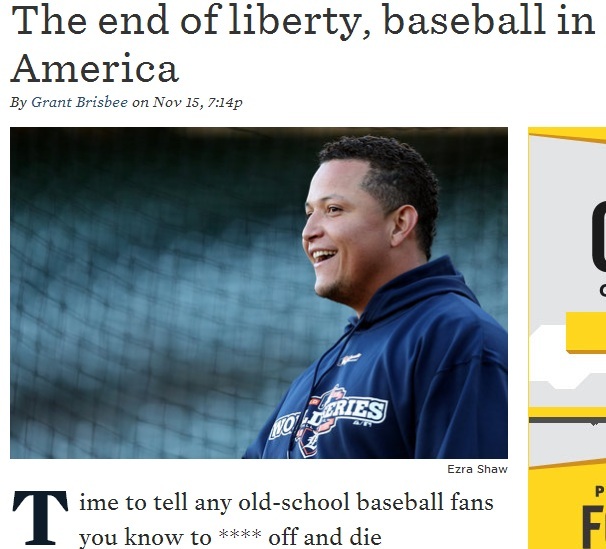
This is on display at SB Nation right now. While the sarcasm is heavy handed, it almost doesn't feel like sarcasm since the Sabermetric stat geeks have had their superiority complex about Mike Trout and the MVP race on full, heightened display before the end of the regular season.
Unfortunately for them, and fortunately for the rest of us normal people, Old Time Baseball won today.
The Sabermetrics geeks were preparing for this day, and before Miguel Cabrera was awarded the AL MVP, they used their mystical powers of WAR to dig back in time and find all of the worst MVPs ever according to their own statistics that are just oh so correct. They all know the WAR statistics are right because it gives their useless fantasy teams victories in their useless fantasy leagues. The geeks think they're so correct that they prepared cute, sort of tongue-in-cheek headlines telling the rest of us unenlightened baseball fans to, ahem, "fuck off an die" when Miguel Cabrera dared to win MVP. Since, you know, we're all such fucking assholes for daring to think that Miggy had an MVP-caliber season.
Well now. Hey Grant, and the rest of your Sabermetric ilk -- it's time for you to answer some questions.
First and foremost: If defense is so important, then how come the teams who played against each other in the World Series were ranked 12th and 27th out of 30 in team defense this year? By the way, the team with the 27th worst defensive stats in 2012 won the World Series.
And let's get to specifics about your holy grail of Sabermetrics: Wins Above Replacement. Who the fuck governs the calculation of this stat, anyway? God almighty? Did Jesus rise on the third day simply to dictate which baseball players are responsible for more wins? It sure seems like that's what you think.
There are so many examples to cite, since baseball has so many players, but let's stick to two great players: Alex Gordon and David Ortiz.
In the 2012 season, Alex Gordon was given a WAR rating of 6.2 -- meaning that he alone was responsible for adding 6.2 wins to his team's win/loss record, according to Sabermetrics. His offensive WAR was 3.8, and his defensive WAR was 1.8.
First off, 3.8 + 1.8 does not equal 6.2, it equals 5.6; so I'm not sure where the extra .8 of WAR comes from. Secondly, Gordon was so spectacular at shagging fly balls in left field that his WAR rating for this is 1.8?
David Ortiz, a DH who succumbed to an ankle injury this past season, had a WAR rating of 2.9 for his abbreviated season. In real world terms, that means Papi's 23 homers and 60 RBIs were worth 2.9 wins compared to Gordon's 1.8 defensive WAR for patrolling the outfield.
So hitting bombs and driving in fucking runs, in the eyes of our Sabermetrics overlords, is somehow only worth .9 more WAR than shagging flies in the outfield.
How does this even make sense?
To add insult to injury, Papi's defensive WAR rating is -1.0 (his offensive WAR was 3.1, so how Ortiz received a 2.9 WAR with 3.1 - 1.0 offensive/defensive WAR is beyond me). He played seven games at first in 2012, didn't make an error, and I don't remember him flopping around the bag, either. Ortiz may not have great range, but I remember him making a decent play on a ground ball hit down the line off Beckett in the Phillies series -- it would have been a double if Papi didn't snag it. Maybe it wasn't a gold glove caliber play, but Beckett recognized Papi's effort on the play by waiting up for Papi and tapping gloves with him before heading to the dugout between innings.
Papi isn't a gold glove first baseman, but he's not that bad, either. He didn't make a single error in the 7 games he played at first. But with a defensive WAR of -1.0, over 162 games WAR dictates that he would have cost the Red Sox 23 games.
Really? Flawless defense at first, showing decent range, would have cost the Sox 23 games? I'm not buying it, that's bullshit.
The Sabermetrics geeks can jerkoff all they want to Mike Trout's WAR rating and how much better it is than Cabrera's, but you know what? None of those geeks can look at their precious statistics and answer why it was that Cabrera turned it up a notch in the last couple months of the season, hitting .344 with 54 RBIs and placing his teammates on his back into the playoffs while Trout's Angels were beat by the Oakland fucking A's.
Mike Trout only hit .286 in the same stretch, and for all the geeks who claim that batting average no longer matters, here's an Old Time Baseball lesson: A PLAYER MUST PLACE THEIR FUCKING BAT ON THE FUCKING BALL TO CREATE FUCKING RUNS. FUCKING DUH. WHERE'S YOUR GODDAMN FUCKING SABERMETRIC STAT FOR THAT? HUH?
The fact -- carved in stone, dyed in wool fact -- is that Miguel Cabrera created more runs when it counted. This shouldn't discount from the fact that Mike Trout had a historic season for a rookie, and no sane baseball fan would say "I can't build a team around Trout" with his age and his monstrous talent. But, as far is the Most Valuable Player award is concerned, Miguel Cabrera heated up during the final two months of the season and carried his team into the playoffs while AL pitchers caught up with Mike Trout, and his .392 batting average in July was brought down over 100 points to .286 in August and Sept/Oct.
If Trout had played at his superior June/July levels for the remainder of the season, the Angels would have made the playoffs and there would be no question about his MVP status.
But the Angels stayed home. The Tigers advanced because Miggy took it up a notch. The Tigers went to the World Series despite having shitty defense from their sluggers, and they were beat by a Giants team with worse defense whose offense clobbered the shit out of them.
This ain't fantasy baseball, this is reality. And it's about time that Sabermetrics geeks were knocked off their high horse and asked to address baseball reality, because unfortunately for them, none of their special statistics reflect this reality.
So, in short, they are wrong. Old Time Baseball wins yet again. And until the Cult of Sabermetrics accept and address reality, they can feel free to get fucked. Because, objectively speaking, they've all been proven wrong and they have some explaining to do.
Suck it.
Subscribe to:
Posts (Atom)